Most people buy a stock, keep an exit price in their head, and move on to the next trade.
Not having a stop order is one of the worst, and most expensive habits a trader can have.
A real stop loss requires you to lock in the risk boundary of the trade at the exact moment you enter. It cannot be fixed after the fact. It is part of the trading system itself — as important as position size.
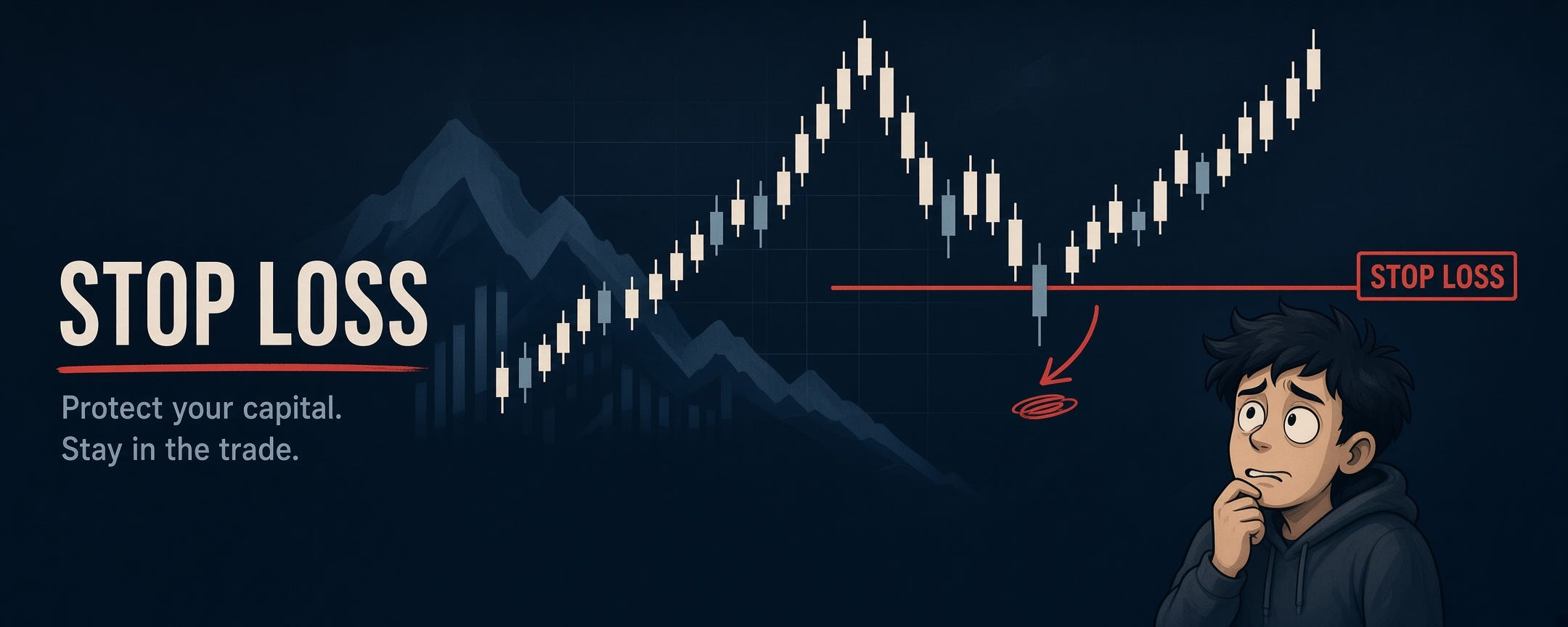
Why the stop must be placed at the same time
1. Emotion is the most expensive cost in trading
Once price starts falling, human instinct turns into “wait a bit longer,” “it might bounce,” or “this time is different.” The longer you wait, the further you tend to push the stop. Eventually you either cut at the worst point, or you hold all the way down near the bottom before finally selling. By then, the better decision might actually be to do nothing — or even to buy — because the thesis and market sentiment have already changed.
Placing the stop at entry means you lock in “when this trade is considered a failure” while you are still calm.
2. The stop directly determines whether you can size the position at all
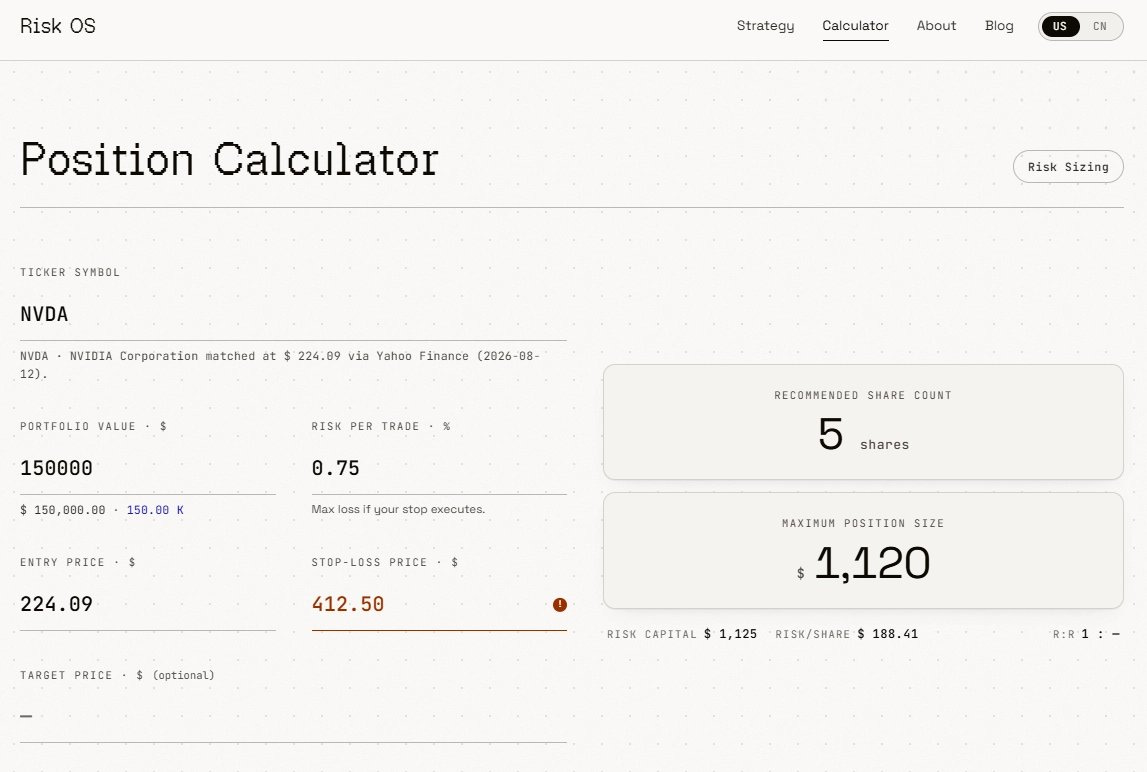
In my Risk OS framework, position size is inseparable from risk percentage, and that percentage depends on the distance between the entry price and the stop.
First calculate: if the stop is hit, how much money will this trade lose at most (usually no more than 1–2% of total capital). Then reverse-engineer the maximum position size from that number.
Without a defined stop, you cannot price the risk properly, and position size becomes guesswork.
3. It is the physical execution of INVALIDATION
Every entry thesis needs a clear condition for “under what circumstances my judgment is wrong.” Simply thinking “I believe it will go up” is not enough, because that gives you no defined exit mechanism.
The stop price turns that condition into an executable order. Without placing it at the same time, the exit remains nothing more than a fleeting idea.
How to design the stop properly
“I’ll just sell if I’m down 10%” is amateur thinking. Real stop placement requires more thought and data, and it comes with traps — lessons that cost me a few hundred thousand to learn.
A proper design should answer three questions:
1. Why is this the price where I’m “wrong”?
Don’t just pick a round number. Ask instead:
On the technical structure, which key support / trendline / gap is being broken?
On volatility, has price moved beyond normal noise (e.g., 1.5–2× ATR)?
On fundamentals / catalysts, has a clear invalidation signal appeared? (This requires constant attention to price, volume, and news.)
The stop should sit at the price where the thesis is invalidated, not at the maximum loss you subjectively feel you can tolerate.
2. Does the risk implied by this stop match the position size?
Suppose you are willing to risk at most 1% of the account.
If the stop is 10% away from entry, you can only put 10% of capital into the trade. If the stop is only 4% away, you can size up accordingly.
Define the risk first, then the size. Never the other way around.
Trading styles differ. I’ve noticed that on names I handle well, the initial stop often ends up in the 7–9% range. But never determine your stop price with a simple fixed percentage.
3. Hard stop or adjustable?
Initial hard stop: placed at entry to protect capital.
Trailing stop: once the trend confirms, raise the stop to breakeven or higher to eliminate risk or lock in profit.
Time stop: if the thesis has not played out after X days, exit actively.
My usual combination is: hard stop at entry + convert to trailing after a key level is broken, or adjust dynamically with ATR.
I sometimes also set a price target at the same time, but that belongs in another post.
Turning the idea into an order
Most brokers now support Bracket Orders / OCO (One-Cancels-Other). Robinhood, the casino, only offers a plain stop order.
Place the stop and the profit target together with the entry. When one side fills, the other is automatically canceled.
This moves the decision from the emotional state during the trade into the rational state before the trade. And trust me: slowing down the order process helps you make better decisions. Don’t enter while staring at tick data. Reduce the flashing colors on the screen as much as possible when you place the order.
The gotchas of stops
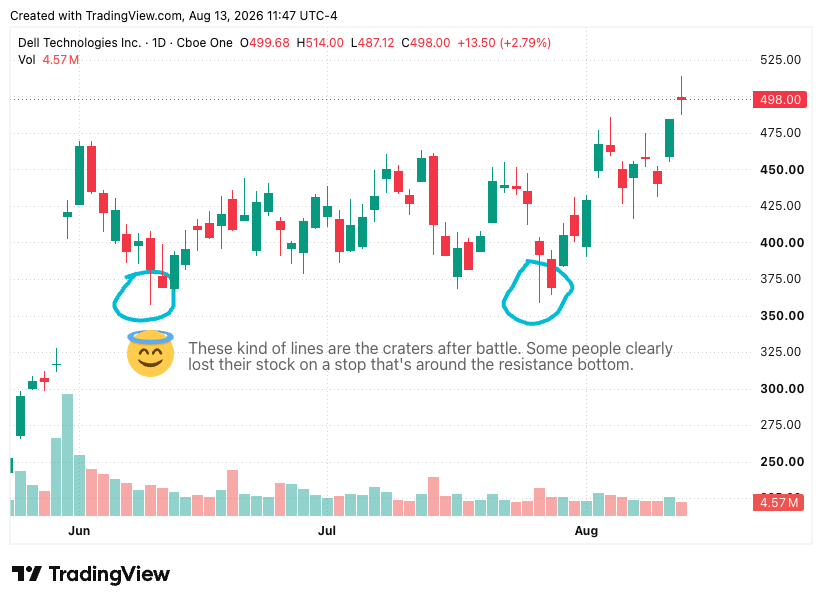
The stop needs to sit beyond the point where key support is invalidated. If you place it too close to that level, sorry — market makers will shake you out.
You’ve seen those long wicks above and below support, right? Those are the footprints left by traders whose shares were stolen by a single needle. I know because I’ve been tested that way many times.
When setting the stop, always look at the stock’s liquidity and daily volatility, then decide how far beyond the support the stop should sit. Sometimes a wider stop is what allows you to stay in the trade until the thesis actually plays out.
After all, none of us wants to die right before dawn, right?
Closing
The real function of a stop is to force you to admit you were wrong.
The best traders are not necessarily the ones with the most precise stops. They are the ones who execute without hesitation once the stop is hit. The only reliable way to achieve that is to have the stop already in place the moment you enter.
The point of a system is that it can still constrain you when you most want to break it.